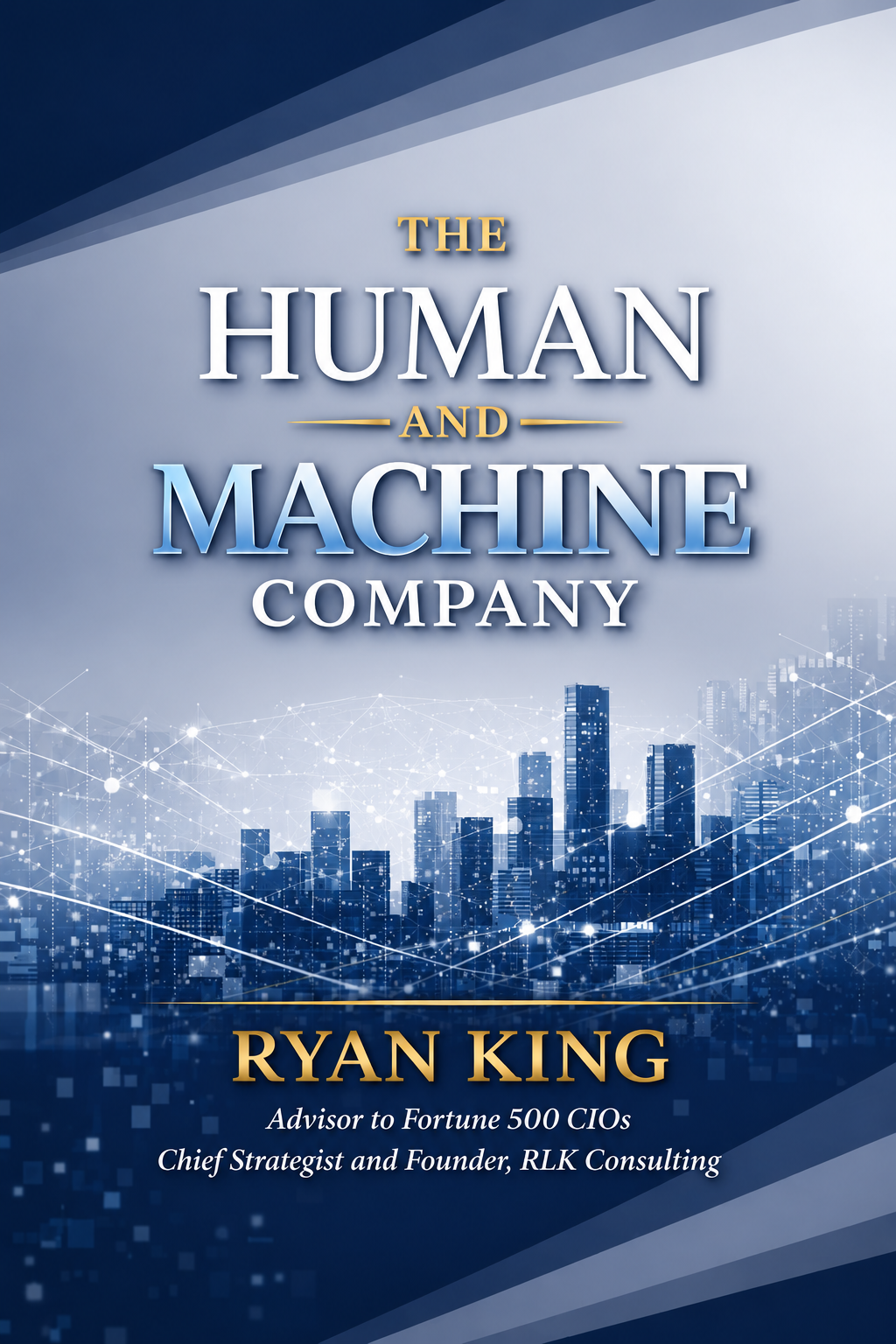
Why an Ebook
AI moves faster than print publishing, so this book ships as an ebook first and gets revised as the evidence grows. This second edition, released July 2026, folds in the newest research on AI and work, adds five chapters on running the human and machine company, and closes with a fourteen-tool appendix. Everyone who requests the book receives the current edition, always. Paperback, hardcover, and Kindle editions are arriving on Amazon for readers who prefer them.
Why It's Free
I wrote this because the problem deserved a clear treatment, not because it was a revenue play. If you lead technology for a living, you should have access to a rigorous framework for thinking about AI and management without paying for it. That's the whole point.
What's Inside
AI is a management transformation, and this book treats it like one.
Most conversations about AI start with models and vendors. Inside organizations, the question that decides outcomes is what AI does to how the firm operates: who decides, who checks, what the middle layers are for, and which steps in a workflow still deserve to exist.
The book draws on over 15 years of advisory work alongside CIOs across Fortune 500 enterprises, mid-market companies, federal agencies, and venture-backed organizations, and on the strongest published research on AI and work, every citation verified against its source. The patterns are consistent. The management response is learnable.
- 2E
New in the Second Edition
The newest research on AI and employment, the junior paradox, the women-and-AI usage gap, five new chapters, and the Toolkit appendix.
- 01-05
Part I: The Misunderstanding
What AI actually changes, why adoption starts in secret, the group-drive trap from electrification history, the pilot trap, and why smaller companies benefit first.
- 06-12
Part II: The AI Adoption Curve
A three-stage maturity curve with a field guide to each stage, the risks that come with it, and the comfortable plateau where most companies stand today.
- 13-17
Part III: Running the Human and Machine Company
What managers are for, governance as a permissions problem, where the work goes as tasks move up the chain, strategy when analysis is free, and the shape of the new firm.
- App.
The Toolkit
Fourteen one-page instruments, from the calendar audit to the stop condition, each built to start inside a month without a vendor.
Who It's For
Four kinds of readers pick this book up. All four leave with the same argument.
Whether you arrived convinced, skeptical, or just responsible for what the company does next, the evidence holds.
CIOs and Technology Leaders
The primary audience. Leaders who have run the pilots, reported to the board, and still need a framework for why enterprise results lag individual productivity.
Mid-Market and Growth CEOs
CEOs of smaller, faster companies. This book documents the coordination advantage mid-market firms currently hold, and how long the window stays open.
The AI Skeptic
For the executive who thinks most AI initiatives are theater, and has the failure data to prove it. This book uses the same data to show exactly where the exceptions pay off.
The AI Enthusiast
For the employee or leader already using these tools every day, who wants the rigor behind why personal productivity has not yet moved the company's numbers.
Free Download
Get the book, free and without a paywall.
Delivered to your inbox. Written for love of the problem.